Software engineer · Waterloo, ON
Hi, I'm Balaji.
SE at Waterloo. Ex-Finta, ex-Shopify, autonomy lead at WARG.
Finta does accounting and taxes for startups. I built the spreadsheet engine under its planning product: custom formulas that pull live accounting numbers into cells, charts, templates, version history, and Google Sheets-style multiplayer over a revisioned operation log. I also cut dashboard load from two minutes to under two seconds and tracked down a Rails association-caching leak that was OOM-killing a worker.
On Shopify's edge infrastructure team I shipped a new SSL stack in Rails and Terraform and moved more than ten services onto it. When a spike of 429s took production down, I worked the incident and added kill switches and smarter retry backoffs. I also pruned over ten million dead hostnames, saving more than $250,000 a year, and wrote the playbooks and incident-response tooling for domain and SSL job processing.
I worked on Shopify's communications platform, which sends over four million emails and push notifications a month, across the React front end, Rails back end, and GraphQL layer. My main project was an email approval workflow that gives campaigns a second pair of eyes before they go out. Faulty sends from human error dropped 80% after it launched.
I joined WARG's autonomy subteam in January 2024, wrote the
waypoint and diversion pathing for the 2024 drone, and have
led the team of 15+ developers for just over a year. We won
AEAC in 2024 and 2025. As lead I moved autonomy into one
monorepo and wrote warg-cli, the tool the onboarding
bootcamp now runs on. I also set the architecture for the ROS
2 airside stack, whose behavior-tree mission controller
survives the kill switch, and for the GPS-free VSLAM pipeline.
I was the technical lead of the AWS Cloud Club. I wrote and ran our Amazon SageMaker workshops, which covered XGBoost, hyperparameter tuning, and AI workflows, and mentored 25+ students through the AWS Certified Cloud Practitioner exam.
I interned on the ERP and web team at YTY Group. I built an employee attendance prediction system with TensorFlow and Pandas, and a Flutter expense-claims app that works offline and keeps users logged in between sessions.
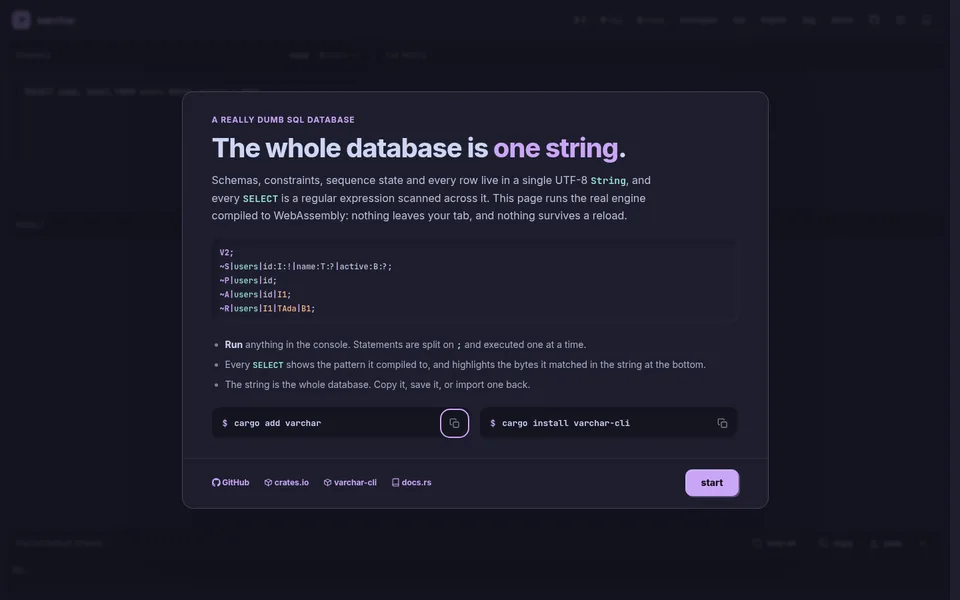
varchar is a really dumb SQL database: its entire state is one UTF-8 string, and every SELECT scans it with regexes. It is still a real parser, type checker, storage codec, and query engine, fuzzed against a reference implementation with random CRUD sequences. The site is the real engine compiled to WebAssembly, with the string and the regex on screen as each query runs.
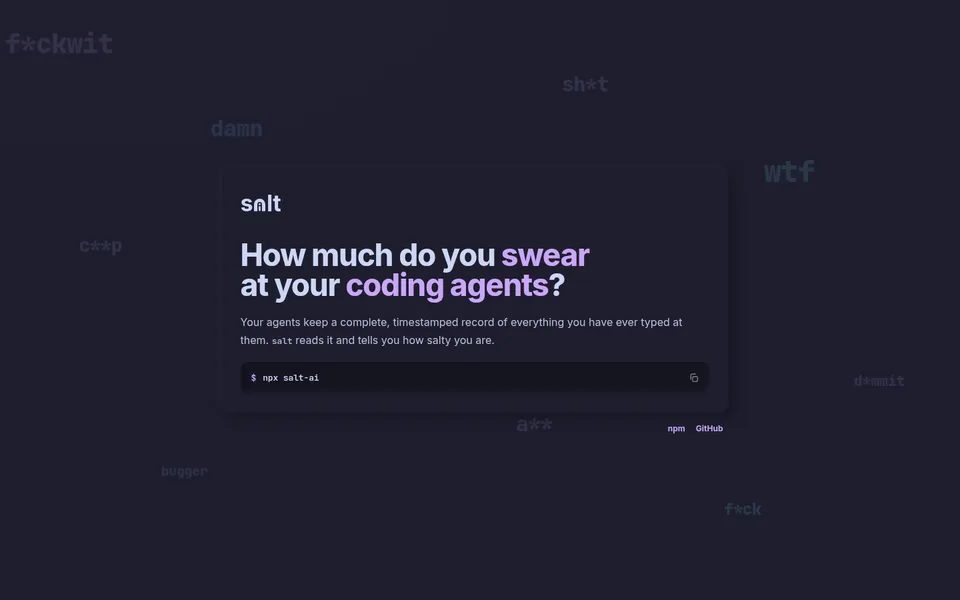
salt reads the session logs Claude Code, Codex, and Cursor keep on your machine, counts the profanity in your prompts, and publishes the counts to a shareable link. The scan is local and disk-bound: 16 GB across 7,900 files in under 4 seconds. Most of the work is filtering out tool results, system reminders, and forked histories, since one prompt showed up 405 times in my test corpus. Reports live in Cloudflare KV for 30 days, and the CLI ships six platform binaries from a 2 MB npm package.
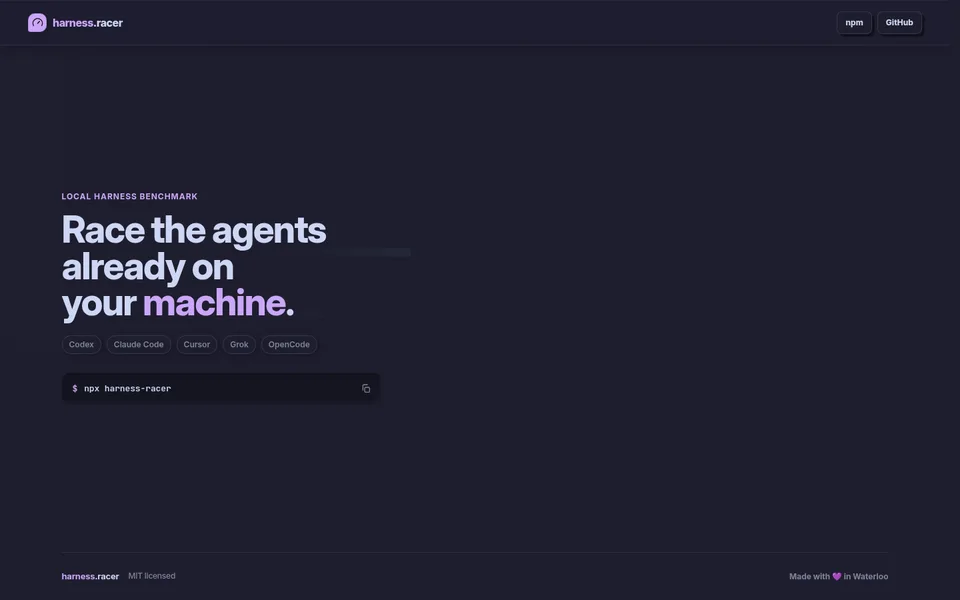
harness racer races the coding agents already installed on your machine, streaming every response live and comparing cold start, time to first output, tokens per second, and time to finish. It drives Codex, Claude Code, Cursor, Grok, and OpenCode behind one event contract that reconciles JSON-RPC, ACP, and SDK streaming. It distrusts its own inputs: one shared tokenizer, medians over repeats, and a run is voided if output arrives in a buffered burst. One benchmark core drives both the browser dashboard and the Ink terminal UI.
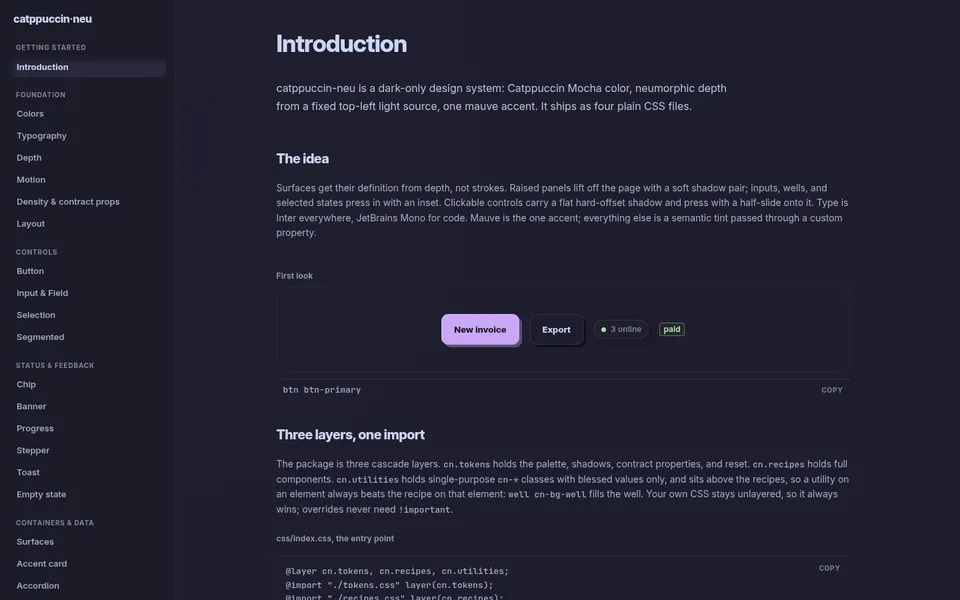
catppuccin-neu is a CSS-only design system in Catppuccin
Mocha. It ships as three cascade layers, tokens, utilities,
and recipes, so consumer CSS stays unlayered and wins without
a single !important. A spec file is the
source of truth for every rule and number in the package. This
site is built on it, and the accordions you are hovering over
are one of its recipes.
warg-cli is the warg command for the WARG autonomy
monorepo. A fresh clone checks out only the root files, then
warg up
materializes a project plus its dependencies through Git
sparse-checkout and warg down unloads them. Each project
declares its own commands in a manifest, like scripts in a
package.json,
so a Python project and a ROS 2 workspace get the same warg run interface.
It is the first thing the autonomy bootcamp has new members
install.
maram, Tamil for tree, is a CLI for git worktree workflows with variant branches and Zellij integration. A worktree set is a base branch plus any number of variant branches, each in its own worktree, so two approaches to the same feature can sit side by side and the winner gets cherry-picked back. Every set gets a Zellij session with a tab per worktree, laid out from a template in the config file.
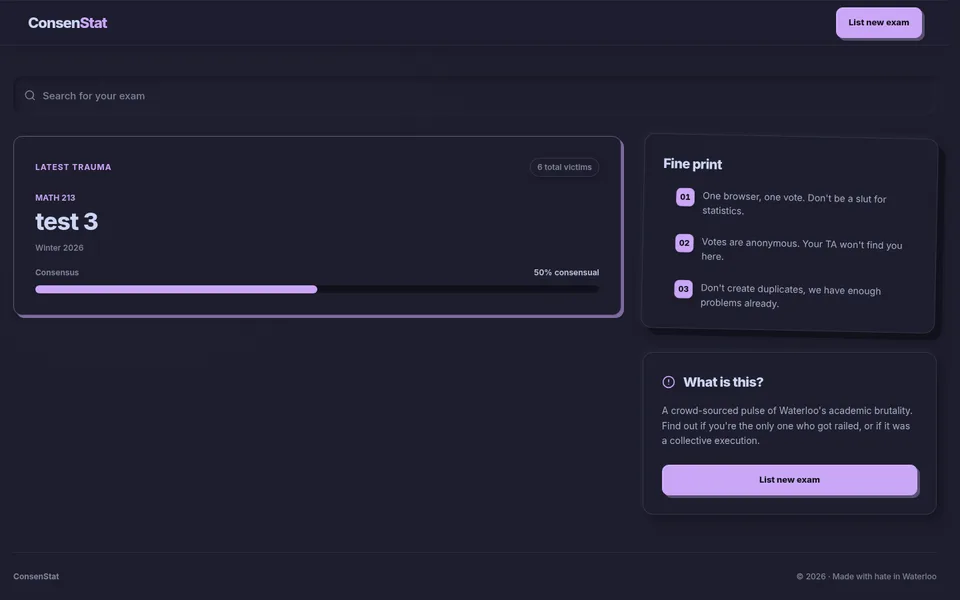
ConsenStat is anonymous, real-time exam sentiment voting for University of Waterloo students. Search for an exam or create one, with duplicate detection, then vote on whether it was touching or touchy. Tallies live in D1 and get pushed to every open tab over Durable Object WebSockets, one vote per browser per exam, with changes of heart allowed.
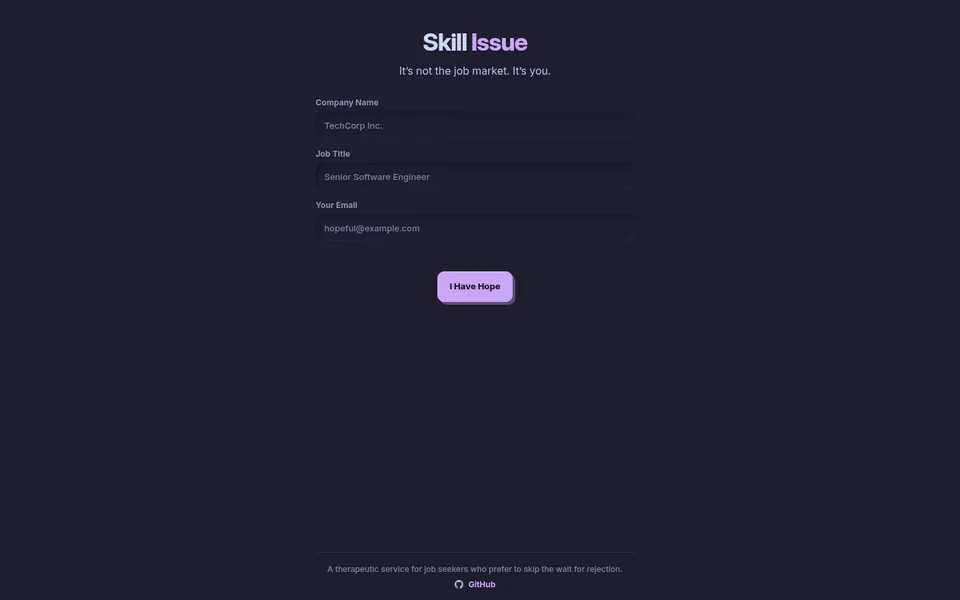
Skill Issue is a therapeutic service for job seekers who prefer to skip the wait for rejection. Enter a company, a job title, and your email, click "I Have Hope," and receive a corporate-parody rejection email 2 to 48 hours later. A Cloudflare Worker takes the submissions, a scheduled job drains the queue out of D1, and Resend delivers the bad news.
herdr-modes adds Zellij-style modes to herdr, a tmux-shaped
terminal multiplexer. Press the prefix, then drum hjkl to keep moving
between panes without pressing the prefix again, while
readline's own ctrl+l and ctrl+k stay yours. A session-modal
popup pane runs the key loop and keeps receiving keystrokes as
focus moves underneath it, and each keystroke goes over
herdr's socket API instead of shelling out, so drumming is
instant.
Linguini is a word game with friends, built with three classmates. You get a category and a timer and name words that fit, and groups keep a leaderboard. I wrote the main game loop on the front end and the tRPC routers for auth, users, and groups. Word validation walks a WordNet hypernym graph in PostgreSQL with recursive CTEs, so a word counts for a category several levels above it.